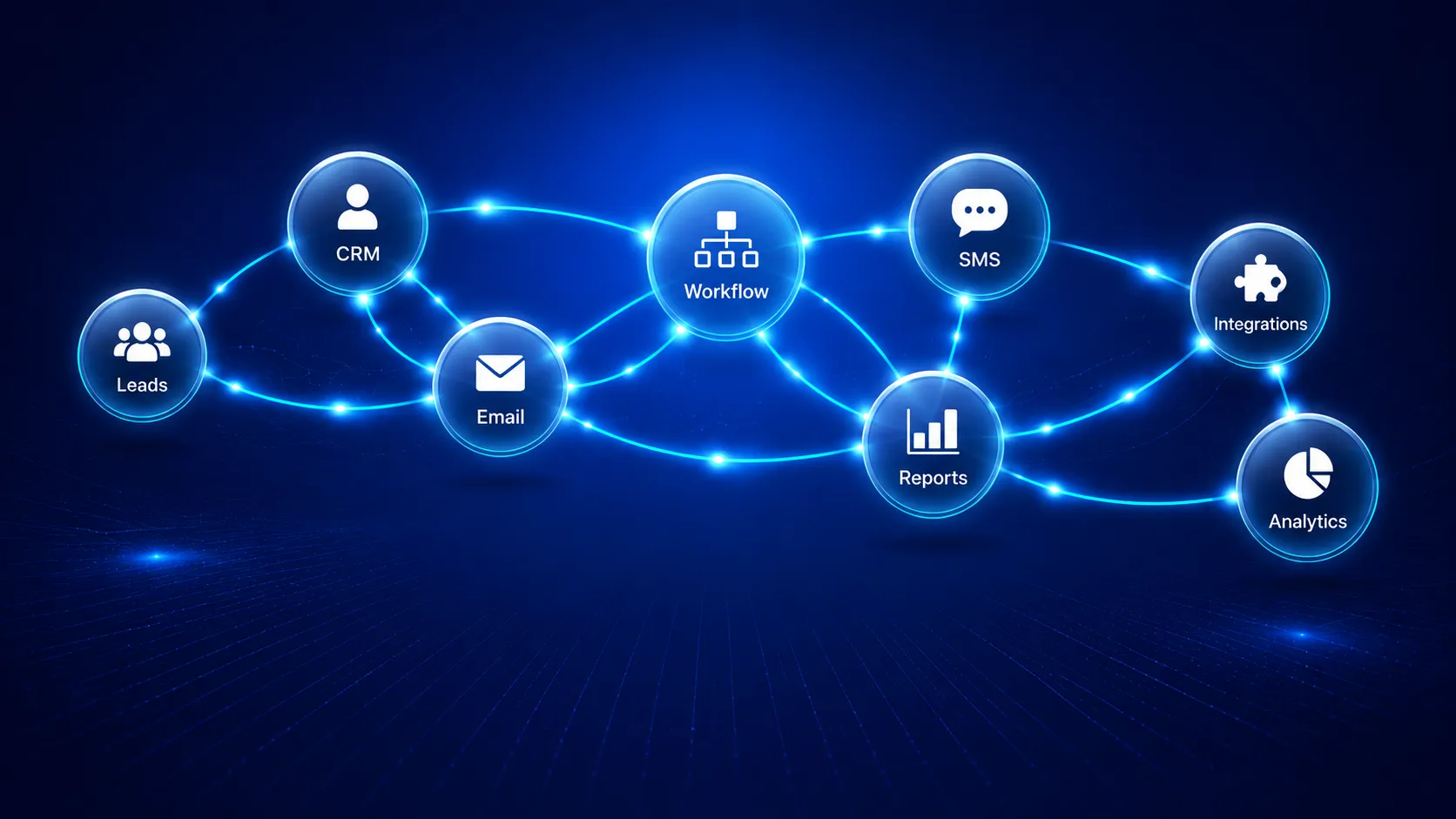
You probably already have the tools.
GoHighLevel. HubSpot. Zapier. An email platform. A form builder.
But client work still slips. Follow-ups get missed. Leads sit untouched for two days. Weekly reports take half a morning to pull together.
Sound familiar?
The problem isn’t your tools. The problem is that your tools don’t talk to each other. And nobody has built the system connecting them.
That’s exactly what a real set of AI marketing solutions fixes. Not a new platform. A connected system built around everything you already use.
This article answers the question directly. Who provides the best AI-powered marketing operations automation framework for managing live client deliverables? And what does that actually look like in practice?
What is an AI-powered marketing operations automation framework?
Here’s the simple version.
An AI marketing operations framework is a connected system of workflows, triggers, and automated handoffs that runs your marketing operation without manual steps in between.
It is not a platform. It is not a software subscription. It is the infrastructure that makes every tool you already own work together as one system.
Here’s what that looks like in a real sequence. A lead fills out a form on your website:
- The system captures and scores the lead automatically based on source and behavior
- It routes the lead to the correct pipeline stage and owner in your CRM
- A personalized follow-up fires within minutes via SMS, email, or WhatsApp
- If there’s no reply, a second touchpoint schedules itself automatically
- Every action logs in your CRM without anyone touching a keyboard
That entire sequence runs 24 hours a day. No manual steps. No human handoffs between tools.
A full framework is dozens of those sequences running at the same time, each one feeding into the next. This is marketing automation using ai across your whole operation, not one tool doing one job in isolation.
Platform vs framework: what’s the actual difference?
| What a platform gives you | What a framework gives you |
| Automation capability to use yourself | Working automations built and tested inside your accounts |
| Tools to create workflows | Workflows already built for your specific operation |
| A login and a dashboard | A connected system running across every tool you use |
| Monthly subscription costs | Infrastructure your team owns outright |
| Self-serve setup and maintenance | Done-for-you build with full documentation at handover |
Managing marketing automation properly means having both. The right platforms, connected by a framework built around your actual operation.
Why your current marketing tech stack isn’t working
Here’s something worth being direct about.
Most teams that invest in AI-powered marketing tools still do manual work. Not because the tools are bad. Because nobody connected them properly.
You set up Zapier. A few months later, half the zaps are broken and no one knows why.
You implement HubSpot. The CRM data is clean for six weeks. Then a campaign fires to the wrong list and no one noticed because the trigger logic was never documented.
This is the automated marketing management gap that software vendors don’t talk about. Buying the tool is step one. Building the working system around it is the actual work. This is the gap that most marketing AI tools simply don’t address. They hand you capability and assume you’ll figure out the rest.
And here’s what makes this harder for agencies specifically. Your clients don’t all use the same tools.
- Client A is on GoHighLevel
- Client B runs HubSpot
- Client C has a combination of three different Zapier integrations built by a freelancer two years ago
Most AI-powered digital marketing tools were designed for single-team environments with one CRM, one email platform, and one clean database. They cannot unify across multiple client stacks. They just add another login to manage.
Why most AI marketing platforms fall short for agencies
Let’s get specific about the gaps.
How n8n, Zapier, and Make each handle automation differently matters a lot when you’re choosing the right backbone for your operation. But even picking the right platform still leaves these problems unsolved:
- Which workflows to automate first and in what order
- How to connect your specific platforms without corrupting live client data
- How to test everything against real contacts before it goes live
- What to do when something breaks six months after the project ends
- How to document the system so your team can actually maintain it
Most agencies don’t get answers to these questions from a software purchase. They get a feature list and an onboarding call.
The difference between a software vendor and a real AI marketing solutions provider is simple. One sells you the parts. The other builds the machine and hands you the keys with documentation.
You can also read our guide on choosing the best automation platform for your workflow before committing to any specific tool.
What a working AI-enhanced marketing automation framework actually covers
A real framework doesn’t automate one thing. It covers your entire operation.
Here are the four areas it needs to handle:
1. Lead management and routing
Getting leads into the right place instantly is where most operations fall apart.
- Captures every lead from every source automatically including ads, calls, forms, and referrals
- Scores each lead based on behavior and intent, not just the source it came from
- Routes leads to the correct pipeline stage and team member without manual sorting
- Fires the first follow-up in minutes, not hours
For a detailed walkthrough, see how to automate lead follow-up without losing the personal touch.
2. Client deliverable tracking
No more chasing approvals or relying on someone’s memory.
- Tasks auto-create when a new project or client kicks off
- Approval workflows trigger without anyone sending a manual email
- Status updates log in the CRM in real time as work moves through stages
- Nothing depends on someone remembering to do something
3. Reporting and attribution
Your clients expect accurate reporting. This is how you deliver it without it eating your team’s time.
- Data pulls from multiple platforms into one view automatically
- Attribution tracked at every touchpoint without manual tagging
- Weekly performance reports go out on schedule without anyone pulling a spreadsheet
4. Cross-platform data sync
This is the piece most agencies overlook until it causes a real problem.
- One contact record updates across every connected tool at the same time
- No duplicate leads inflating your pipeline numbers
- No conflicting data between your CRM and your email platform
What this looks like in a real build:
A RevOps client came to Agentum managing work across four separate platforms that weren’t communicating with each other. The build unified all four into one connected system covering deterministic attribution, dedup-safe lead ingestion, nine distinct workflows, and fifteen pipeline stages. All of it ran inside the client’s existing accounts from day one. You can read the full breakdown in the SaaS and RevOps case study.
That’s what AI-enhanced marketing automation looks like when it’s built correctly. Not a demo environment. A live system running real client data.
How to evaluate any AI marketing automation provider
Most agencies get burned here. A project ends, the workflows get handed over, and then three months of troubleshooting follow because nothing was built inside the actual live environment.
Before you sign anything, run through this checklist.
| Question to ask | What a solid answer looks like |
| Where do you actually build? | Inside your live accounts from day one, not a demo environment |
| Who owns the workflows at the end? | You do, with written documentation handed over at launch |
| How is the project scope defined? | Fixed quote agreed in writing before any work starts |
| What does handover include? | Loom walkthrough, written docs, and a post-launch support period |
| Do we need to switch platforms? | No, they work with whatever you already use |
| What happens when something breaks? | Clear documentation and a support process already in place |
Three things worth pushing harder on before you commit:
Build environment. If a provider won’t build inside your live accounts from the start, you end up doing the integration work yourself after the invoice is paid. That defeats the purpose.
Account ownership. Some providers build inside their own accounts and charge monthly access fees. When the relationship ends, the system goes with them. Every workflow and integration should live inside your accounts from day one.
Fixed scope. Open-ended retainers with no defined deliverables are how marketing automation projects double in cost. Get a specific list of deliverables and a fixed price agreed before any work begins.
How Agentum AI builds marketing and sales automation systems
Agentum AI builds custom AI marketing solutions for small and mid-sized businesses and marketing agencies across the US.
Every project follows the same process.
Step 1: Free audit call, 30 minutes
Agentum maps where your operation is breaking down, what a connected system needs to cover, and what it will cost. You get a written scope and fixed quote before any work starts. No vague roadmaps. No retainer until the scope is defined and agreed.
Step 2: Phased build inside your live environment
Every workflow is built inside your actual accounts using the tools you already have. Each phase gets tested against real data before moving to the next stage. Nothing gets handed over untested.
Step 3: Launch with full documentation
At launch you get a Loom walkthrough covering the full system plus written documentation for every trigger, integration, and data flow. One week of post-launch support is included in every project.
Platforms Agentum works with:
| Category | Tools |
| CRM and pipeline management | GoHighLevel, HubSpot, Airtable |
| Workflow and process automation | n8n, Zapier, Make, Power Automate |
| Lead generation and outreach | Clay, Instantly.ai |
| Voice agents and communications | Retell AI, Twilio |
| AI logic and processing | OpenAI |
You keep every account, every workflow, and all documentation when the project ends. No lock-in. No platform migration. No ongoing access fees.
For marketing agencies:
Agentum builds white-label AI automation systems inside your clients’ own accounts. Your agency delivers the outcome and owns the client relationship. Agentum builds the AI automation marketing infrastructure running behind it.
This lets your agency offer AI-powered marketing operations as a service without hiring in-house automation specialists or spending months building the capability from scratch.
Agentum has built more than 50 live systems across more than 50 businesses. If your goal is growing the operation without adding headcount, see how the scale without hiring model works. And if you want to understand what a project like this costs before you decide, the AI automation pricing breakdown covers exactly what drives the number up or down.
Frequently asked questions
What is an AI marketing operations automation framework?
An AI marketing operations automation framework is a connected system of workflows and automated triggers built across your existing tools. It handles lead capture, routing, follow-up, client deliverable tracking, reporting, and cross-platform data sync without manual handoffs between steps.
Who actually needs a marketing operations framework?
Marketing agencies managing multiple client accounts benefit most. So do operations teams at growing businesses whose current process relies on someone remembering to do something. If your team still manually follows up with leads, chases approvals by email, or pulls reports by hand, a framework addresses all of those gaps directly.
What is the difference between buying marketing automation software and hiring Agentum?
Marketing automation software gives you the capability to build workflows. Agentum builds the workflows themselves inside your live environment, tests them against real data, documents everything, and hands the whole system over to you ready to run.
How long does it take to build an AI marketing operations system?
It depends on the complexity of your operation and how many platforms need to be connected. Agentum uses a phased build process, so parts of the system go live and are tested incrementally rather than everything deploying at once.
Does Agentum work with the tools we already use?
Yes. Agentum builds inside GoHighLevel, HubSpot, n8n, Zapier, Make, Airtable, Instantly.ai, Retell AI, Twilio, and OpenAI. You do not need to switch platforms or migrate data.
Do marketing agencies get a different service from Agentum?
Yes. Agentum offers white-label builds inside client accounts for agencies. The agency owns the client relationship. Agentum builds the automation infrastructure behind it. This is covered in full on the white-label AI automation page.
The bottom line
Most businesses don’t have a software problem.
They have a systems problem.
The tools exist. GoHighLevel, HubSpot, n8n, and Make can handle nearly everything a modern marketing operation needs. But buying them doesn’t give you a working system. Someone still has to design the logic, build the workflows, test them in a live environment, and document how everything connects.
That is the work. And most vendors skip it.
Book a free AI automation audit with Agentum. We will map what’s breaking in your current stack, scope a connected framework to fix it, and give you a fixed quote before any work begins.
No open-ended retainers. No platform migrations. Just a working system inside the tools you already use.