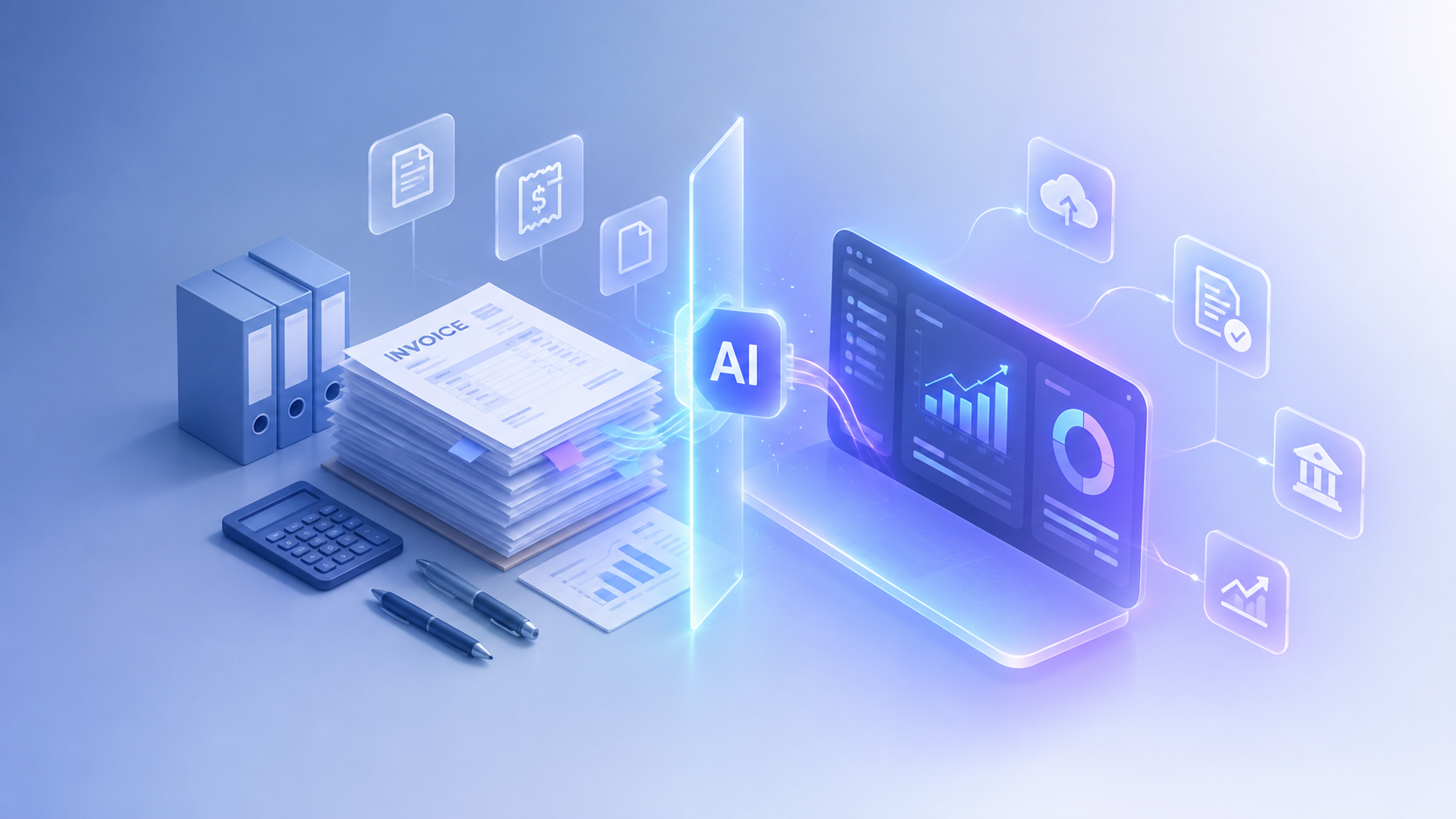
AI adoption among CPAs jumped from 9% in 2024 to 46% using it daily by early 2026, according to the Wolters Kluwer Future Ready Accountant report. That’s a fast shift for a profession built on precision and professional judgment, and it’s brought real regulatory attention with it.
AI automation for accounting firms covers everything from bookkeeping and invoice processing to month-end close, but tax and audit work in particular now come with specific professional guidance worth understanding before you rely on AI too heavily. This guide covers both.
AI bookkeeping automation and transaction categorization
AI bookkeeping automation reads bank and credit card transactions and categorizes them automatically based on patterns from your chart of accounts, instead of a bookkeeper manually assigning categories line by line. Transaction categorization AI improves over time as it learns from corrections, though it still benefits from periodic review, especially for unusual or judgment-heavy transactions.
Bank reconciliation automation
Bank reconciliation automation matches transactions in your books against bank and credit card statements automatically, flagging discrepancies for review instead of requiring a manual line-by-line comparison every month. This is one of the more mechanical, repetitive tasks in accounting, and one of the clearest early wins for automation.
Automated invoice processing and accounts payable automation
- Invoice data extraction pulls vendor, amount, and line-item details directly from a received invoice, no manual data entry required
- Approval routing sends the invoice to the right person automatically based on amount or vendor
- Payment scheduling happens on the agreed terms, without someone tracking due dates manually
- Automated invoice processing flags duplicate or unusual invoices for review before payment goes out
Accounts payable automation reduces both the manual time cost and the error rate that comes with manual data entry across a high volume of invoices.
Month-end close automation
Month end close automation handles the repetitive parts of closing the books each month:
- Automatically pulling and reconciling account balances
- Flagging accounts that haven’t been reconciled or reviewed yet
- Generating standard close checklists and tracking completion
- Routing final review to the right person once automated steps are complete
This typically shortens the close cycle without changing who signs off on the final numbers.
Financial reporting automation and anomaly detection
Financial reporting automation generates standard reports, P&L, balance sheet, cash flow, on a set schedule, pulling from the same reconciled data rather than requiring manual report-building each period. Anomaly detection accounting tools flag unusual transactions or account movements that fall outside expected patterns, surfacing things worth a closer look before they become a bigger problem.
Client onboarding and document collection automation
Client onboarding automation for accountants handles the repetitive setup work for a new client: collecting engagement letters, gathering prior-year documents, and setting up their file in your practice management software automatically. Client document collection automation extends this on an ongoing basis, requesting and tracking the documents needed for tax season or a specific engagement, rather than a staff member manually chasing down missing items.
AI tax preparation and compliance: what current guidance requires
This is where recent regulatory attention matters most. In June 2026, the IRS Office of Professional Responsibility issued its first formal guidance on AI in tax practice, OPR Alert 2026-19, applying existing Circular 230 obligations to AI-assisted work.
| Area | What the guidance requires |
|---|---|
| Professional judgment | AI should assist, not replace, professional judgment. Final decisions must rest with a qualified professional. |
| Due diligence (§10.22) | Preparers remain responsible for the accuracy of AI-assisted work, the same as any other work. |
| Billing (§10.27(a)) | Charging clients for manual labor time that AI actually replaced can constitute an unconscionable fee. |
| Staff procedures (§10.36) | Firms should train staff on AI use and establish protocols for secure data handling and accuracy monitoring. |
The AICPA takes a consistent position: AI-generated output should be verified the same way you’d verify anyone else’s work, treated as a draft, not a finished, client-ready answer. And the liability question has a clear answer across every source on this: when AI makes an error in a financial statement, tax filing, or audit opinion, the CPA is liable, not the software vendor.
This isn’t legal or professional guidance for your specific firm, confirm current requirements with your own compliance resources or counsel, since standards continue to evolve.
Audit automation: what it actually means
Audit automation typically applies AI to specific procedures, testing full populations of transactions instead of a sample, flagging anomalies for auditor attention, and automating routine documentation, rather than replacing the auditor’s judgment or sign-off. Professional standards are consistent on this point: using AI or data analytics tools doesn’t reduce the auditor’s responsibility for professional skepticism and the final opinion. Audit automation extends what an auditor can efficiently examine, it doesn’t change who’s accountable for the result.
Accounting firm workflow automation: putting it all together
Accounting firm workflow automation works best when these pieces connect into one flow:
- Transactions get categorized automatically as they come in
- Invoices get processed and routed for approval without manual entry
- The books get reconciled on an ongoing basis, not just at month-end
- Close and reporting happen faster, with anomalies flagged for review
- Client documents get collected and tracked automatically ahead of deadlines
- A qualified professional reviews and signs off on anything AI-assisted, every time
How Agentum AI builds AI automation for accounting firms
We build automation across bookkeeping, invoicing, close, and client document collection, connected to the practice management and accounting tools your firm already uses, with professional review kept exactly where it belongs. You can see the accounting automation work we do in more detail.
If you’re ready to reduce the manual workload without compromising on professional standards, book a free automation audit and we’ll map it out.
Final thoughts
AI automation for accounting firms genuinely reduces the manual workload behind bookkeeping, invoicing, and close, but the professional judgment behind tax and audit work stays exactly where it’s always been, with a qualified person who reviews, verifies, and signs off. Recent IRS and AICPA guidance make that expectation explicit, not optional.
If you’re ready to see what automation looks like for your firm without cutting corners on professional standards, book a free automation audit and we’ll build it around how you already work.